| HOME | SEMINAR 1 | SEMINAR 2 | SEMINAR 3 | SEMINAR 4 | SEMINAR 5 | REFERENCES | VIDEO RESEARCH | DISSERTATION | RESOURCES |
 |
| DON |
| RESEARCH |
| PSYCHOLOGY |
| DEVELOPMENT |
| SPIRITUALITY |
| CHILDREN |
| FAMILY TREE |
| HOLIDAYS |
| CAMP |
| HOMETOWN |
| WHEATONCHURCH |
Video and Audio Media in Qualitative Research |
|
Video and Audio Media in Qualitative Research by Don Ratcliff, Ph.D.
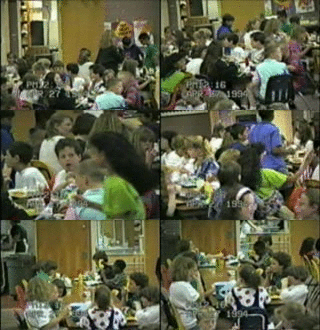
This is a working draft of a booklet on conducting qualitative research using a camcorder. Much of it is the product of my research with children in an elementary school located in North Georgia. While I was conducting that research, which eventually resulted in a dissertation at The University of Georgia, I kept careful notes on video and audio data collection methods. I regularly experimented with different ways of collecting data with one and sometimes two camcorders (the second used by an assistant who videotaped me videotaping children), as well as using various ways of collecting audio data, to discover what approaches worked best for different situations. While my dissertation emphasized the social groupings of children in the school hallway, I also gave considerable attention-- four chapters --to the methods used in collecting and analyzing my data. After writing the dissertation and obtaining my doctorate, I went back and examined my methodological notes again to discover in greater detail the effects of my experimenting with video and audio collection techniques, an issue mentioned but not elaborated in my dissertation. This first draft was written in 1996. An abbreviated version of this book was published as a chapter in Qualitative Research in Psychology , edited by Paul Camic, et. al., and published by the American Psychological Association in 2003. The video segments described in the latter source are available online, if you have Windows Media Player enabled on your web browser. Click here to see the video.
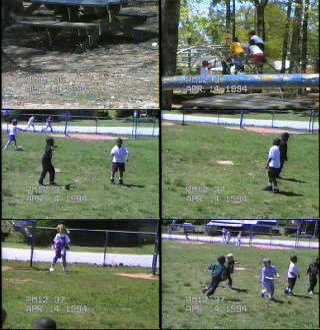
Five additional video segments of the hallway and three video segments of the school playground are also available. Click here and scroll down the page to find links to these video segments. I hope that you may find some useful ideas in my comments. I appreciate any feedback you wish to offer. I'm sure there are areas where it needs more attention. Perhaps someone will work with the manuscript, share authorship, and see it published, but for now I am happy if it encourages you to use video in your research and gives you some ideas of how to do it. Don Ratcliff, Ph.D. Chapters converted to PDF files 8-18-04 Note that some of these files are pdf format and require Adobe Reader, which can be downloaded without charge by clicking here .
Contents: 1. BACKGROUNDS, STRENGTHS, AND LIMITS 2. PURPOSES, ETHICS, AND VISIONS 4. THE MECHANICS AND ART OF VIDEOTAPING 5. SOUND RESEARCH: THE AUDIO TRACK 6. TRANSCRIPTION, ANALYSIS, AND CONCLUSIONS Download entire book in one file
soli deo gloria
Former member
|